
In this article
A ballroom, a vineyard and a lookout on the roof. Rockton’s story is much larger than the three-room cottage with which it began.
At 4 Rockton Street in Newtown, this Ipswich home brings together layers of building, family and local history. The original wing dates to 1855; the house around it evolved over generations. This article expands on my Rockton carousel and the video below.
Local history · Not for sale. Rockton is a private residence. Please respect the residents’ privacy.
Watch the Rockton story
Playing loads Instagram’s embedded player. If it is unavailable, watch the video on Instagram.
Is it Ipswich’s oldest home?
The careful answer is more interesting than an absolute claim. The Queensland Heritage Register describes Rockton’s 1855 wing as apparently the oldest surviving building in Ipswich. That is a statement about a surviving part of the house—not proof that the entire present-day building dates to 1855, or that it was the first house ever built in the city. Queensland Heritage Register, entry 600552.
William and Sabina Craies began with a three-room brick cottage. Early expansion followed, with William Hancock associated with the building work. The home would continue to grow and change rather than remain a fixed picture of one year.
When the garden held 2,000 vines
An 1862 sale advertisement gives a remarkable glimpse of the property’s earlier life. It described Rockton on 7½ acres, with a vineyard of 2,000 vines, fruit and vegetable gardens, stables, a coach house and detached bathing facilities. These are details from the historical advertisement, not a description of the property today.
The notice advertised a mortgagee-directed auction for 5 September 1862. It also listed a separate land parcel, which should not be added to the area attributed to Rockton itself. See the original Courier advertisement, 28 August 1862.
A breezeway became a ballroom
According to the Picture Ipswich history, the Bullmore family lived at Rockton from 1877 and bought it in 1882. Their changes included enclosing a breezeway as a ballroom and adding a second storey. A private water pipeline and a separate billiard room were also part of this chapter.
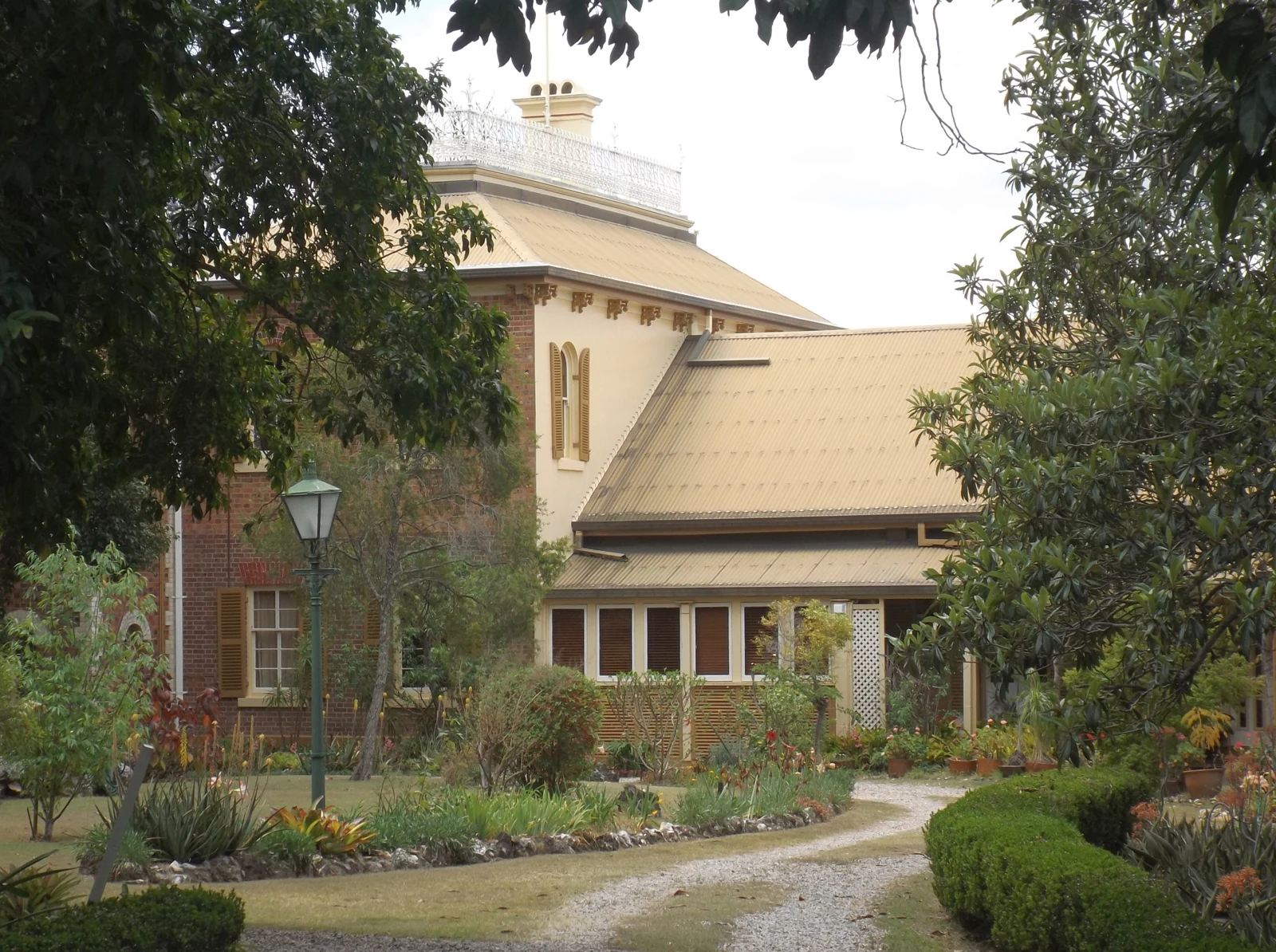
The rooftop widow’s walk is one of the home’s most distinctive details. Viewed through the garden, its iron balustrade hints at the way successive owners reshaped the house around their lives. Read the Picture Ipswich history of Rockton.
The Haenke family chapter
Will and Laura Haenke bought Rockton in 1918. Further alterations followed, including a large bay window and later changes to the internal arrangement. In 1945, a separate residential area was created for Willis and Helen; a swimming pool followed in 1953.
Rockton also became part of a creative life. The University of Queensland records how Helen Haenke’s poems, short stories and paintings reflected her life at the home. Its rooms and outlook offered more than a backdrop: they were part of the world she observed and wrote about. UQ: Helen Haenke remembered at Rockton.
One address, many chapters
Rockton entered the Queensland Heritage Register on 21 October 1992. The surviving house and garden hold evidence of many periods, rather than a single untouched moment in time.
That is what makes local property history worth exploring. A building can show us how people lived, what they valued and how a city changed around them. In Newtown, one home has been gathering those stories for more than 170 years.
For another Ipswich home with a very different transformation, explore the story of 13 Whittaker Street.
Photograph: Shiftchange, Wikimedia Commons, CC0. Historical research reviewed in September 2026. Source dates refer to the records described; the article does not establish unverified renovation dates or architect attributions.
